Walking through the gates of my old school in Damascus was more emotional than I expected.
For so many years, returning to Syria was impossible. But now, after the fall of the Assad regime, I found myself standing in the courtyard of the school where I had spent much of my childhood.
My school was originally built during the French Mandate in Syria. Then, it was known as Lycée Laïque — the “School of Secularism.” During the Assad era, it was renamed after Bassel al-Assad, becoming Ma’had al-Basel. When I studied there, there were around fifty students in each classroom. We wore uniforms that resembled military attire and while some teachers were exceptional, the school system itself encouraged one-way instruction rather than curiosity or critical engagement.
Today, things have changed again, and my childhood school now carries the hopeful name Lycée of Freedom.
But, while buildings can be renamed overnight, transforming education takes much longer.
Today, Syria faces many challenges. Undoubtedly, one of the most important is the need to rebuild Syria’s education system. After speaking with education specialists, Action Syria’s local partners on the ground, teachers and colleagues working inside the country, I have come to see five interconnected priorities that will be essential for rebuilding education in Syria.
The most visible challenge is physical. Without safe classrooms, children simply cannot return to learning.
Thousands of schools remain partially or completely destroyed. Others continue to operate with inadequate facilities and overcrowded classrooms, sometimes holding sixty or even sixty-five students. Even now, some displaced families are choosing to continue living in temporary camps — not because their homes remain uninhabitable, but because local schools are still closed.
That’s why we’ve been working with our local partners, Abjad Initiative and MARS Organization, to restore three schools in rural Damascus this year. While our resources are only a drop in the ocean compared to what’s needed, each project has demonstrated the difference restoring access to education makes – for children, families and communities alike.
Schools cannot recover without teachers. 14 years of conflict in Syria has significantly interrupted teacher training and forced many experienced educators to leave the country.
In Syrian schools today, many teachers are university students or recent graduates. They often have limited formal training and are working alongside many experienced teachers who have remained despite immense hardship.
In the day-to-day, teachers are faced with overcrowded classrooms, and expected to support children who have experienced displacement, loss and trauma. Many students are returning from neighbouring countries having studied under completely different education systems. Others, particularly those returning from Turkey, may struggle to read or write Arabic confidently after years of studying in another language.
Teachers need practical support, continuous professional development and recognition of the extraordinary role they now play in supporting a generation of children who have experienced so much.
As part of our work, we are continuing to explore potential programmes that combine teacher training with mental health and psychosocial support – recognising that improving teachers’ wellbeing is not separate from improving learning outcomes—it is fundamental to it.
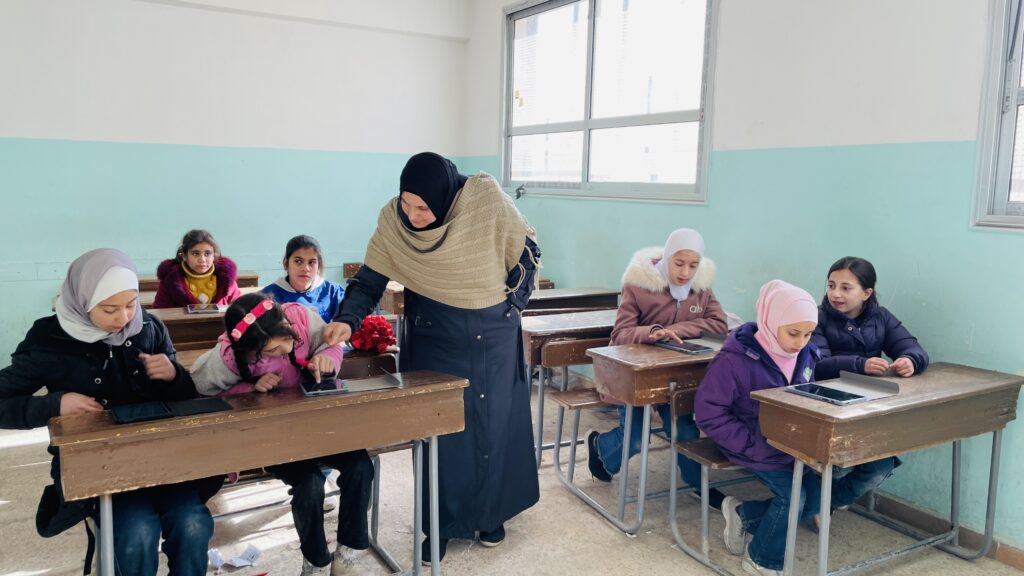
A teacher and their students at Zamalka Primary School in rural Damascus – a school rehabilitated by Action Syria and our local partner, Abjad Initiative.
After conflict, curriculum reform is always politically sensitive and contested.
Syria’s transitional government have already removed some of the most explicit political content from school textbooks, including references promoting the Ba’ath Party and quotations from Hafez al-Assad that students were required to memorise.
This was an important first step.
But, rewriting a national curriculum is a far bigger undertaking than removing political content. And, the goal should not simply be new textbooks. Rather, it is about building a curriculum that encourages critical thinking, inclusion and respect for diversity, while helping young people build the skills and confidence they need for the future.
14 years of conflict and displacement have impacted Syrian students differently. Some students attended school consistently throughout the conflict. Others have missed years of education altogether. Many have studied through informal learning programmes, while others have followed Turkish, Lebanese, or Jordanian curricula as refugees.
This means children are returning to Syrian classrooms with vastly different levels of knowledge, language ability and emotional wellbeing.
Recovery cannot mean expecting every child to fit back into a standard system. Instead, schools will need bridging programmes, language support and flexible approaches that recognise the diverse abilities, learning styles and educational journeys of their students.
After conflict, getting back to learning is not simply about catching up academically. It is about rebuilding confidence, belonging, stability and hope.

Today, 449 children are learning in safe classrooms at Al-Nashabiyeh Mixed School in rural Damasus – thanks to the partnership of Action Syria and Abjad Initiative
Finally, perhaps the most overlooked part of educational recovery is the role that families and communities play. Schools thrive when parents are engaged and communities feel ownership of education.
Before the fall of the Assad regime, many inspiring initiatives in north-west Syria established parent committees, student councils and school-community partnerships. Despite incredibly difficult circumstances, these initiatives demonstrated that education becomes stronger when schools are accountable to the communities they serve.
Now, as Syria rebuilds, strengthening these relationships could become one of the country’s greatest assets.
For me, standing once again in the corridors of my old school highlighted the importance of this moment for Syria’s future.
Syria has a once-in-a-generation opportunity to reimagine its education system. Not simply to restore what existed before, but to build something more inclusive, more resilient and better suited to the aspirations of its young people.
No single organisation can achieve this alone.
At Action Syria, we are committed to playing our part – standing with Syrian communities and supporting vital education projects for as long as we are needed. We are continuing to work alongside trusted local partners, who understand the needs of their communities best, to explore the possibility of supporting teacher development, community engagement and innovative approaches that place children at the centre of recovery.
If you are an educator, researcher, donor, foundation, policymaker or organisation with expertise in education, we’d love to hear from you. Whether you can contribute funding, technical expertise, innovative ideas, research, or simply help connect us with others, your support can make a meaningful difference for Syrian communities.
Syria’s future will be shaped in its classrooms. Together, we have an opportunity to help ensure those classrooms become places where a new generation can learn, heal and thrive.
Written by Anas Darkawi, Action Syria Interim CEO
Anas Darkawi (Syrian-British) is an international development and civil society practitioner with 20 years of experience in the non-profit sector, supporting positive social change across the MENA region, with a particular focus on the Levant.
He holds a Master’s in International Management from the University of Exeter and a second Master’s in Youth and International Development from Brunel University London. Throughout his career, Anas has been a passionate advocate for youth participation and empowerment.
His work spans organisational development, leadership coaching, training, impact assessment, grant-making, and strategic consulting. Anas is deeply committed to localisation, sustainability, and amplifying the voices of marginalised communities.

Keeping supporters clued up on our work is important to us. Sign up to keep up to date with where the funds go and the impact they have, and how you can support us.